The colourful crops saving Shetland’s ‘species on the edge’
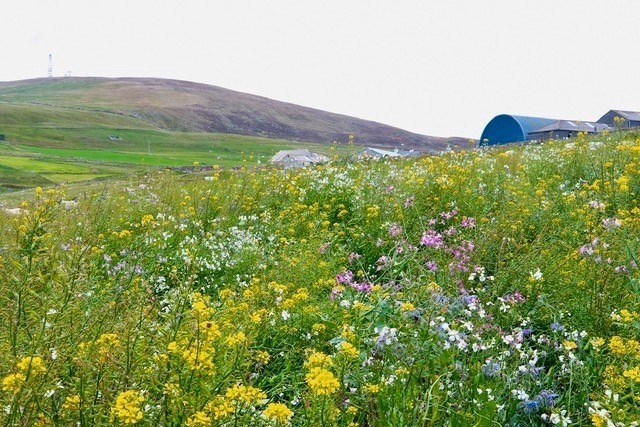
Keen-eyed Shetlanders will have perhaps noticed patches of yellows, purples and pinks adorning the landscape this summer, as a new project looking to conserve some of the UK’s rarest and most vulnerable wildlife bears fruit – or flower.
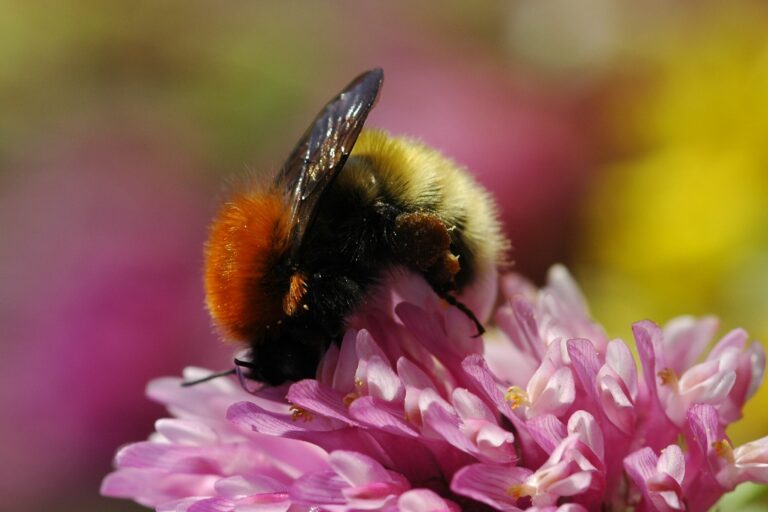
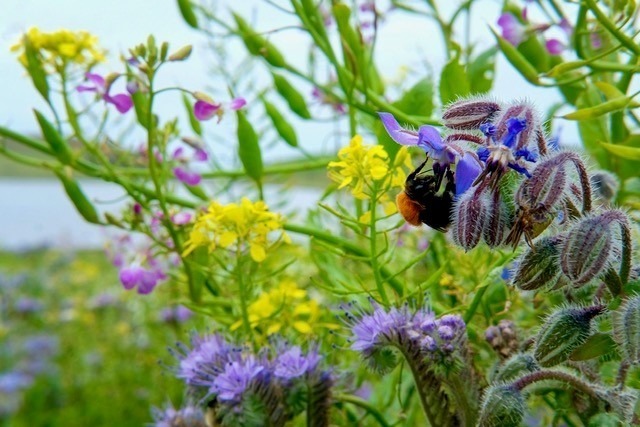
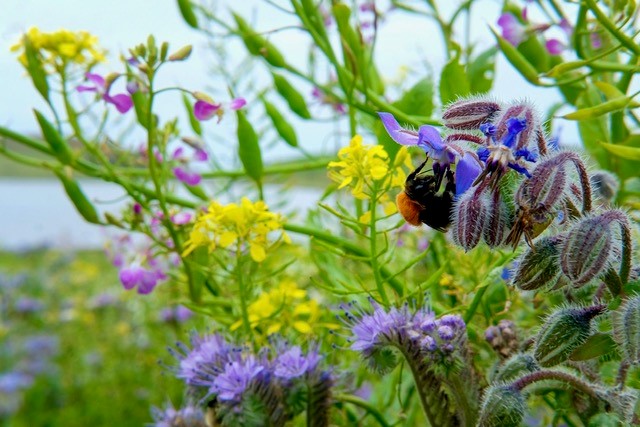
24 crofters across Shetland have teamed up with Species on the Edge to grow over 40 plots of these multi-coloured crops, nick-named ‘Bumblebird crops’. The crops have been grown from seed mixes which have been specifically designed to support a range of wildlife. In the summer, the crop nourishes a variety of pollinators including the very rare ‘Shetland bumblebee’. Easily recognisable by its bright, Lucozade-orange thorax, this subspecies of the moss carder bumblebee can only found in Shetland, Orkney and some of the Scottish western isles and nowhere else in the world.
In the winter, once the flowers have gone to seed, the crop provides a vital food source for seed-eating birds that remain in Shetland over winter, such as the Linnet, Brambling and the Lintie (Shetland name for the Twite).
Why do Linties need our help?

The Lintie is in sharp decline across the UK, an impact of the drastic changes in land use of the past century to increase agricultural productivity. In 1999, England had an estimated 587 breeding pairs of Twite; this year, it’s looking like breeding pairs are now down to single figures. Scotland is home to the majority of breeding Twite in the UK, but here too numbers are in decline.
Shetland provides a stronghold for Twite in Scotland, but the landscape here is also changing, and Linties are struggling as a consequence. Twites are seed-eating birds so rely on a healthy supply of diverse arable crops and seeds to survive the winter. Where previously inbye land in Shetland was a diverse crofting mix of crops, meadows and grazed pasture, much of the farmland now is dominated by species-poor grassland grazed by sheep or made into silage. Describing this change in the landscape, Laughton Johnston wrote in his book A Naturalist’s Shetland: “It’s as if the patchwork quilt has been thrown away for a plain blanket”. The result is a vast reduction in sources of food, both for pollinators in the summer and for seed-eating birds, such as Twite, in the winter.
The ‘Bumblebird’ seed mix contains species such as kale, mustard, fodder radish, phacelia and linseed. The species are non-invasive, short-lived agricultural cultivars which are quick to grow, addressing the urgent need for increased sources of food for Shetland’s pollinators and birds. The crops benefit the crofters too, adding nutrients and organic matter into the soil, promoting better soil health which will benefit future crops. Alongside the ‘Bumblebird crops’, crofters are also being encouraged to establish longer-term, unimproved meadows where possible, using some of the remaining species-rich meadows in Shetland as donor sites for seeds of local provenance.
Matt Willmott, Shetland Conservation Officer for RSPB, said about the project: ‘Species on the Edge has been a breath of fresh air – rapid, targeted habitat management on the ground in Shetland to help pollinators and Linties. Central to this are the crofters, and it has been great to use their current and historical knowledge and expertise to achieve quality wildlife crops in such a short space of time. It really does feel like the patchwork quilt is at last beginning to be stitched back together’.

“if I can even put one of those squares back onto the patchwork quilt, that’s making a bit of a difference” – Donna Smith, crofter
Donna Smith is a crofter in Shetland who began working with Species on the Edge in early 2024 to grow a Bumblebird crop on her land. She said: “My family croft was bought by my granddad in the 1940s, just after the Second World War. When my granddad had it, we had cows, sheep, chickens, oats, potatoes, Shetland kale, Shetland cabbage. Once my dad took it over, for various reasons the croft changed a bit. They got rid of the cows, they stopped growing the crops and it basically was put over to sheep. He was working full time as a teacher and the sheep were easier to work with. Just like the way that Shetland and a lot of the mainland has gone, the crops became the less important thing.
When I started to think about taking over the croft, one of the things I wanted to do was diversify it and make it more suitable for wildlife. I was speaking with Matt and he told me about this project. The croft is 12 acres, the soil is very thin and there’s only a few areas where it’s flat enough to be ploughed, but Matt suggested just planting a little bit where we could, so that’s what we did.
A couple of months later in the summer, the crop was just absolutely full of bumblebees – you could hear them buzzing away. And then it was really exciting in December when we heard Twite for the first time. We rushed down to have a look with the binoculars and we saw two Twite. It’s been really exciting.
To begin with I had thought: ‘it’s quite a small area, is it going to make any difference?’. But I keep coming back to that quote from Laughton Johnston where he says that it’s as if Shetland’s patchwork quilt has been replaced by a plain blanket. I felt that if I can even put one of those squares back onto the patchwork quilt, that’s making a bit of a difference, and if everybody can do a little square, that’s going to make a massive difference.”
“Once the crop became established we were almost overwhelmed by it in terms of colour, smell and sound” – Laura Sinclair, crofter
Laura Sinclair is also a crofter in Shetland; her family own and tenant multiple crofts located in South Scousburgh and Spiggie. She said: “Ours is a typical Shetland family crofting enterprise. We have 12 suckler cows, 130 breeding sheep, and a small flock of ewes. We used to grow tatties, some neaps and oats, but now the only thing we have is a silage crop, on top of the livestock.”
Laura got involved with the Species on the Edge project towards the end of 2023, and in summer 2024 got to see her ‘Bumblebird crop’ come to life. She said: “Once the crop became established we were almost overwhelmed by it in terms of colour, smell and sound. It was just buzzing with bumblebees and other pollinators throughout the summer. It stayed this way until the first gales in September. It then went to seed in around November/December, and that’s when the twite arrived in their numbers; instead of buzzing with bees it was chirping with twite.”

Have you seen any ringed Linties?
At the same time as the Bumblebird crop project, Species on the Edge is conducting a Lintie monitoring project, to learn more about Shetland’s Lintie population and to measure the impact of the Bumblebird crops. In November and December 2024, the team attached coloured rings to over 120 Linties and are now asking the public to record sightings of ringed-Linties.
Species on the Edge Project Officer for Shetland, Harry Britton, said: “In Shetland, we are working closely with crofters across the islands, helping them support wildlife on their land in ways that benefit both biodiversity and their business. These colourfully ringed Twites are going to give us a glimpse of how these threatened birds are using our changing landscape and will help inform the guidance we can offer to landowners, to help them ensure a sustainable future for their local vulnerable species.”

If you see any ringed Twites, please email: kevin.kelly@rspb.org.uk. Please include the date of the sighting, the location and any pictures.
Please note that the ‘Bumblebird crops’ are a live agricultural crop. Even if you think you see a Shetland bumblebee, a ringed twite, or you just want to see the flowers up close, please do not walk through the crop. It is on a crofter’s land and the area contributes to their livelihood and the health of their croft. Disturbance to the crop can also impact the chance of Linties being able to access the seeds later in the year.
If you’d like to learn more about Species on the Edge in Shetland, or you are interested in discussing whether you could grow a Bumblebird crop on your land, please get in touch: kevin.kelly@rspb.org.uk.