By Sally Morris, Species on the Edge Project Officer (Buglife). First published on the Buglife blog 3/4/2026.
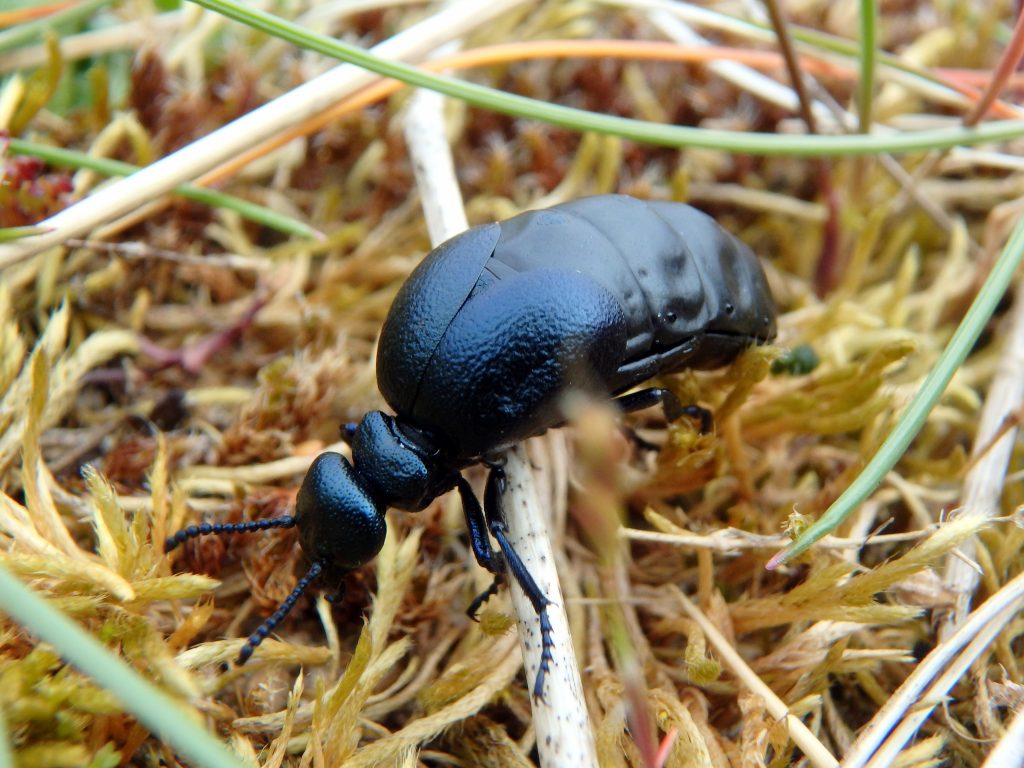
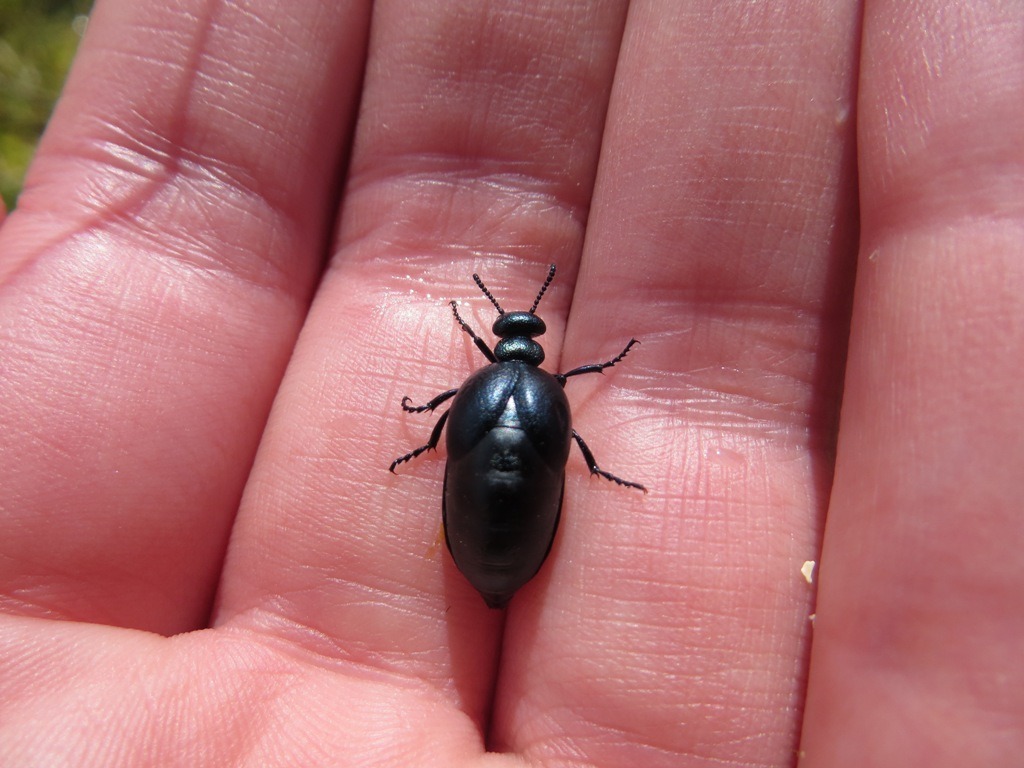
Spring has sprung and it is time for some of Scotland’s most charismatic beetles to emerge! From March to June, oil beetles are often seen wandering across paths in wildflower-rich areas including grassland, heathland and coastal areas, especially on sunny days. Hard to miss, the shiny black beetles have a slight blue or green sheen to their appearance and some species will grow to over 2.5cm in length. These beetles are commonly described as looking like they’re wearing an ill-fitting waistcoat! The waistcoat being made up of short wing cases that do not fully cover the beetle’s abdomen.
The Scottish Oil Beetle Hunt

Buglife has been advocating and raising awareness of oil beetles for a number of years. 2026 will be the fourth year running the Scottish Oil Beetle Hunt, a citizen science survey encouraging people to look out for these amazing beetles and record any sightings (recent or historical!). There are five species of oil beetle in the UK, only three are found in Scotland, these are the Black Oil Beetle (Meloe proscarabaeus), Violet Oil Beetle (Meloe violaceus) and the Short-necked Oil Beetle (Meloe brevicollis).
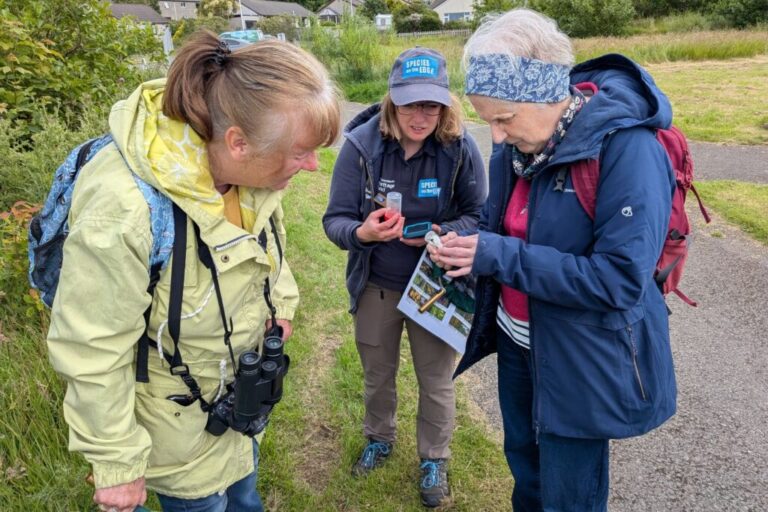
Over the past five years, there has been a massive increase of Scottish oil beetle records on iRecord (a website and app for biological recording), with very few records prior to 2021. To put things in perspective, there were only 30 records from 2016-2020, increasing to a whopping 546 records from 2021-2025. Increased recording due to the Species on the Edge programme is in part responsible for this. As part of my role, I have carried out 74 surveys for the rare Short-necked Oil Beetle across the Hebrides over the past three years. In addition to these surveys, sightings from keen individuals and naturalists have resulted in exciting expansions to their known distribution. Sites for the Short-necked Oil Beetle in the Outer Hebrides have risen from two known sites in 2021 to ten sites in 2025.
Sally dives into the history books

Whilst recent records are crucial in understanding current species distribution, historical records are equally important and can give us an idea of species change over time. Last year, I visited the National Museums Scotland Entomology Collections in Edinburgh, and the Glasgow Museums Entomology Collections to look at the oil beetles within their collections. Both collections have records dating from the mid-1800s with over 2.7 million insect specimens combined. I had a brilliant few days, looking through drawers of oil beetles collected from all over the UK. Many were from 200-odd years ago, and looked as if they could have been collected yesterday, until you got a bit close and the musky old smell gave it away! I was also lucky enough to look at some of the UK’s now extinct oil beetle species, including the Rainbow Oil Beetle (Meloe variegatus) and the Scarred Oil Beetle (Meloe cicatricosus).
With so many specimens, digitising the data associated with them is a time-consuming challenge, so my main objective was helping the collections digitise the data associated with their oil beetle specimens. The collections are working towards sharing their digital data with the NBN Atlas, the UK’s largest repository of publicly available biodiversity data, and the Global Biodiversity Information Facility (GBIF). This will ensure data is more easily accessible for use by researchers and conservation organisations in the future.
Get involved!
However you’re interested in helping out oil beetles, whether that’s biological recording, spreading the word or assisting with old records, Buglife would love to hear from you! No prior knowledge is needed to take part in the Scottish Oil Beetle Hunt, anyone and everyone is encouraged to submit records using the iRecord app (with multiple photos if possible), or to send in details via email. Let us know what you find using #OilBeetleHunt on social media! A handy identification guide to the different oil beetle species can be found on the Buglife website – Join the Oil Beetle Hunt.
Species on the Edge runs this survey in partnership with the National Oil Beetle Recording scheme, launched in 2021. This scheme was established to help us understand more about oil beetle abundance, distribution and ecology in the UK. Thanks are due to the NMS Collections Centre in Edinburgh and to the Glasgow Museum Entomology Collections for assisting with my visits.