Connecting with nature with Louise
Louise, our People Engagement Officer for our north coast project area, has been out and about helping local communities, schools and volunteers connect with nature and take action for their local ‘species on the edge’. Here’s a look at what she’s been up to.
Relaxing with nature
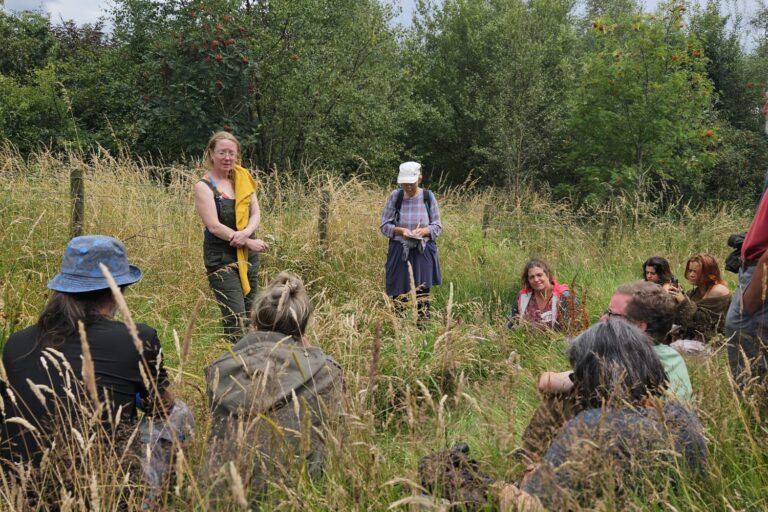
Louise has been working with Iain Black from Flow North Yoga and Wellbeing to roll out a series of ‘Tools for Nature Relaxation’ workshops across the Caithness community. The workshops delve into the science behind why deepening our relationship with nature can benefit our wellbeing, as well as fostering a greater sense of responsibility for the natural world. The sessions provide a toolbox of tips and techniques for slowing down and strengthening our connection with the natural world on our doorstep – or even outside our window.
One tool that we shared during the workshops is our “Caithness Nature Relaxation Film” which features footage of well-known environments in Caithness overlaid with a guided meditation written by Iain. You can watch the film here:
North Coast goes national!
We were delighted to make a national television appearance this summer, as Hamza Yassin and the BBC Countryfile team came to learn more about our work for Small Blues at Dunnet Community Forest. Our volunteer and Nature Hero, Daniel, showed the makings of a future Hamza as he enthusiastically told viewers about the tiny but mighty butterfly, and even found some barely-visible-to-the-naked-eye Small Blue eggs for the crew to zoom in on.
You can catch the segment in the 25 June 2025 ‘Orca Watch’ Countryfile episode on BBC iPlayer. The small blue feature begins at 25:39: Orca Watch | BBC iPlayer

Conservation comic book
The team are working with artist, Aimee Lockwood, to produce a north coast conservation comic book! Kicking off with a scoping workshop which drew on the collective knowledge of professionals and volunteers involved in conservation work across the area, followed by a series of workshops with schools and community groups, the process has been collaborative throughout.
Louise and Aimee spent the summer delivering a series of comic book workshops focused on the north coast’s amazing wildlife and designed to tap into participants’ creative skills to draw out their thoughts on conservation. Through the workshops, over 150 people have had the opportunity to contribute their ideas, stories and artwork to the comic book creation.
Aimee will spend the winter working through all these materials, pulling everything together into a coherent narrative that celebrates the north coast’s diverse species and the wonderful work that is being done to protect and care for them.
Aimee has been keeping a sketch diary of all the Species on the Edge activities she took part in over the summer. Here are a couple of pages from it – aren’t they fantastic?! We are even more excited for the final comic book now!


Lichen forays
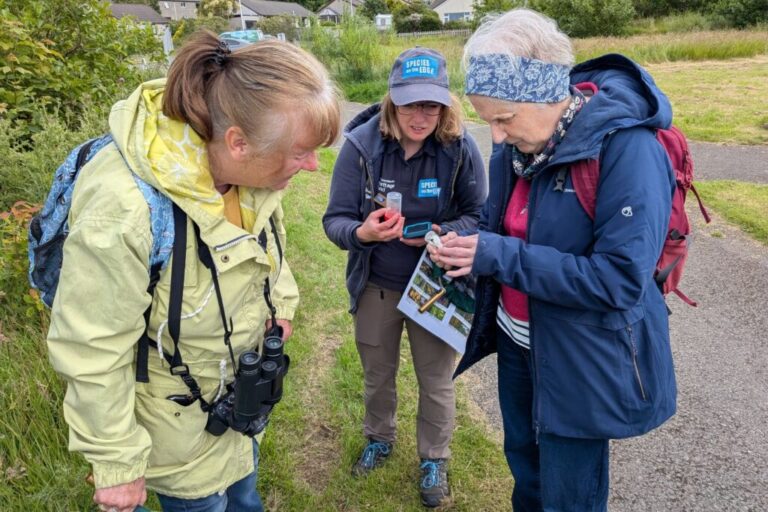
Whilst we don’t have any lichen on our list of 37 priority species, Species on the Edge is all about encouraging people to take note of the amazing natural world around them. With Plantlife’s lichen and bryophyte specialist, Dr Oliver Moore, visiting the north coast in August, it was too good an opportunity to miss, so one of the highlights of our summer was the series of lichen forays he delivered for us!
With events in Dunbeath, Borgie, Reay and Dunnet, almost fifty people were whirled away to a world in miniature under Oliver’s expert guidance. People described feeling like “a child in a treasure hunt” or like “being at a magic show” and several people commented on how much they valued spending time with like-minded people and learning to see a familiar place through new eyes.

Work parties
A big shout out to our pals at RSPB Forsinard who have been loaning us their working holiday volunteers to help with habitat management at some of our Small Blue butterfly sites. As well as an early scythe and rake at Castlehill to remove the heavier vegetation ahead of the Highland Council cut on the wildflower meadow, with the extra people power we have been able to establish three plots for a moss removal trial in Dunnet dunes.
The Dunnet dunes have long been a stronghold for our Small Blue butterflies because a natural, dynamic dune system supports a healthy kidney vetch population. Unfortunately, dune stabilisation caused by the restrictions of the road to the southern side and marram grass growth throughout have led to a build-up of moss which kidney vetch (the sole foodplant of the small blue caterpillar) cannot penetrate. We have cleared the moss out of three large tracts; one will be planted with kidney vetch plug plants, one will be seeded only, and the other will be left as a control plot. We will monitor the vegetation over the coming years to determine whether this is an effective strategy, and our results will be used to inform land management decisions in other parts of the UK.

Species surveys with Sarah
Senior Project Officer, Sarah Bird, has had a busy season of surveying our north coast ‘species on the edge’. Here’s a look at what she got up to and some preliminary findings:
Scottish Primrose
With the help of a few dedicated volunteers, Sarah has now surveyed 95% of the Scottish Primrose sites in the north coast area; there are just a few islands and a couple of places on the east coast to cover next year. Results need more time for analysis, but so far we can see that there are good bits and bad bits. So far it seems that there are more areas showing declines than increases, but the well-known hot spot at Strathy Point continues to have a very healthy population of Scottish Primroses.

Purple Oxytropis
Sarah has now surveyed the extent of the area on the north coast where Purple Oxytropis grows. It’s been tricky as it mostly likes to cling on to cliffs and steep, inaccessible places. Again, results need more time for analysis, but there seems to be good news for this plant. At many sites Sarah was expecting to find a few plants in discreet patches, but, when she peered over the edge (literally!), she saw thousands stretching along the cliffs for long distances. Here’s some visualisations showing the increase in Purple Oxytropis records we have managed to achieve through Species on the Edge so far.


Oysterplant
This summer, volunteers have continued to survey for Oysterplant, either using the phone App, or a recording sheet. It’s a nice one to look for as it grows on the beach. Most records from this summer are in similar places to last year. A hint of plants at Bettyhill turned out to be a false alarm, but there were plenty to see around Castletown.
And then there’s Dounreay nuclear site in Caithness… This site was the UK’s centre for fast reactor research and development, with its first fast reactor providing electricity to the national grid in 1962. Now the site has an ongoing large-scale clean-up and demolition project run by Nuclear Restoration Services.
The Dounreay area has one of the longest surviving Oysterplant populations in the UK (that we know of), with records from here going back 130 years. Here’s a bit more information of the history of Oysterplants at this site:
- Pre 1884: First known records at Isauld (east of Sandside Bay) by Dr H Balfour (who died in 1884, so he must have seen the plants before that year). He was an eminent Scottish botanist prominent in the foundation of the Botanical Society of Edinburgh in 1836, which later became the Botanical Society of Scotland, and was Her Majesty’s Botanist in 1845.
- 1902: The Oysterplant was noted by another important botanist, G.C.Druce. He saw “.. very beautiful and plentiful Oysterplants near Dounreay on shingle”.
- 1900 to 1925: Records made between Sandside bay and Lower Dounreay, but noted as scarce in 1925.
- 1976 to 1986: The next records of Oysterplant at the site, including from Ken Butler, physicist and former assistant director of Dounreay. After he retired he studied local wildflowers and published Wild Flowers of the North Highlands of Scotland in 2013, a marvellous book!
- 1986 to 2024: No records; the site is no longer easily accessible due to the Dounreay reactor.
And that brings us to today. This summer, Sarah headed to the site to look for Oysterplants, the first time in 40 years that anyone has surveyed Oysterplant here. Sarah was escorted to the beach at Dounreay Castle by armed guards and was stunned with what she found.
Sarah recorded over 500 plants at Lower Dounreay within the NRS Dounreay site, making it the largest Oysterplant population on the north Scotland coast, and one of the largest populations in the UK. The shore where the Oysterplants grow is very protected by natural rocky reefs and concrete piers, so the plants should be safe there for many years. Large protected populations like this one are called ‘nucleus colonies’ and are essential for the long term survival of this fragile species. Oysterplant is a very mobile plant as seeds are carried by the tide to then germinate at new sites, creating new populations; so the plants at Dounreay may well produce new plants all along the Caithness coast for us to find and enjoy!
Thanks goes to the NRS Dounreay Green Network for making access to this site possible (and to their volunteers who have been helping with Scottish Primrose and Small Blue butterfly surveys!).


Plans for winter
After another busy summer, things will quieten down for the winter. Sarah and Louise will be taking time to reflect on the things they’ve learned this year and to plan the year ahead. They’ll be working together with our north coast volunteers and local partners to put in place strategies to ensure that Species on the Edge can leave a useful legacy on the north coast beyond the end of the programme.
Details of our events for the 2026 season will come to our Species on the Edge north coast mailing list subscribers so, if you’re a subscriber, watch out for them, and if you’re not a subscriber, well you better get signed up now! Join our mailing list!