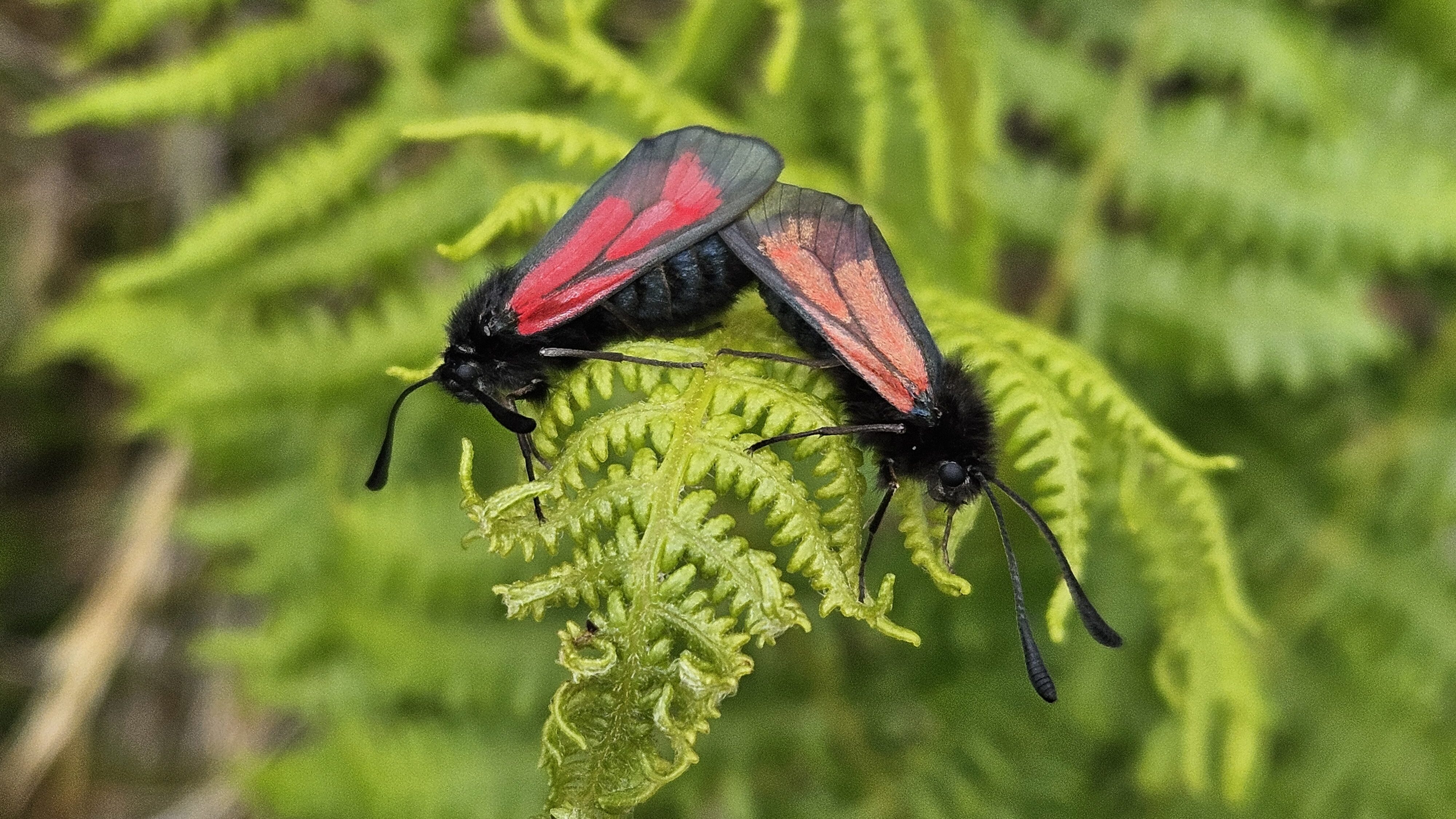
In Argyll and the Inner Hebrides, our Trainee, Mhairi, has been expanding our knowledge of the distribution of Scotland’s Transparent Burnet moths. In this blog she details her rigorous methodology that has led to her rediscovering some of Argyll’s ‘lost’ Transparent Burnet moth colonies. We are also delighted to announce that Trainee Mhairi is no longer a trainee, but is our newest Project Officer for Argyll and the Inner Hebrides! Congratulations Mhairi!
Blog post by Mhairi Hume, Species on the Edge Project Officer for Argyll and the Inner Hebrides, Butterfly Conservation
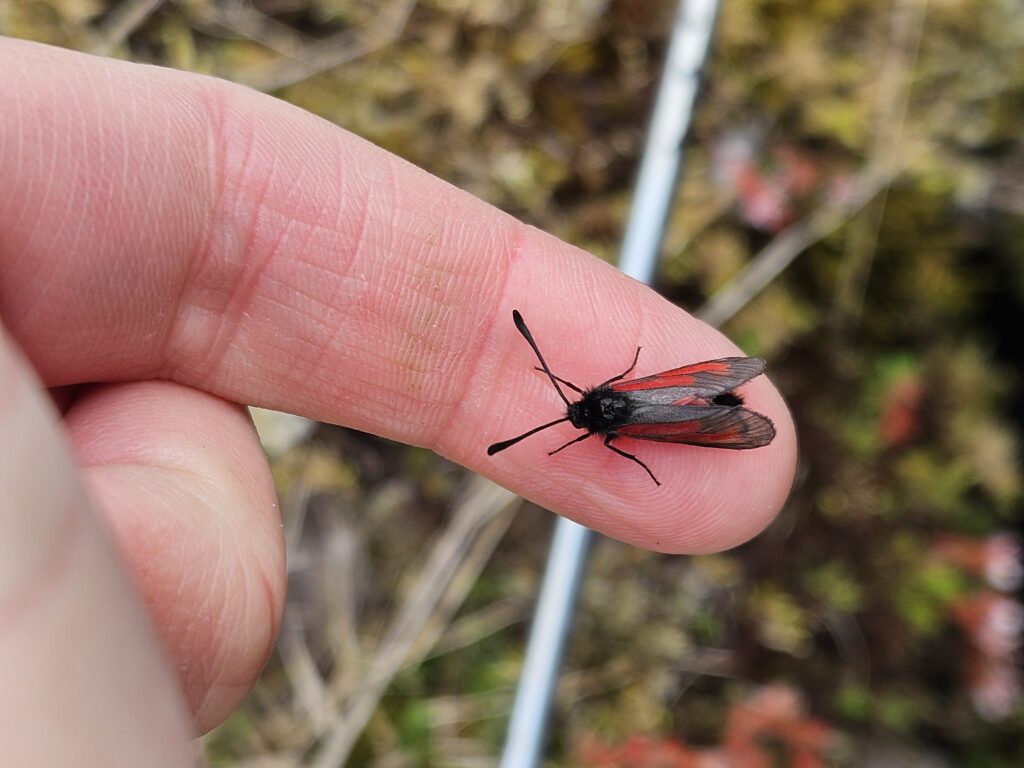
The Transparent Burnet moth is one of our five lepidoptera priority species in the Argyll and Inner Hebrides area. It’s a beautiful wee moth, with bright red streaks running down its black wings, a fluffy body, and clubbed, butterfly-like antennae. Its flight could be described to be somewhat similar to a bumblebee’s – a heavy, slow flight rather different to many moths.
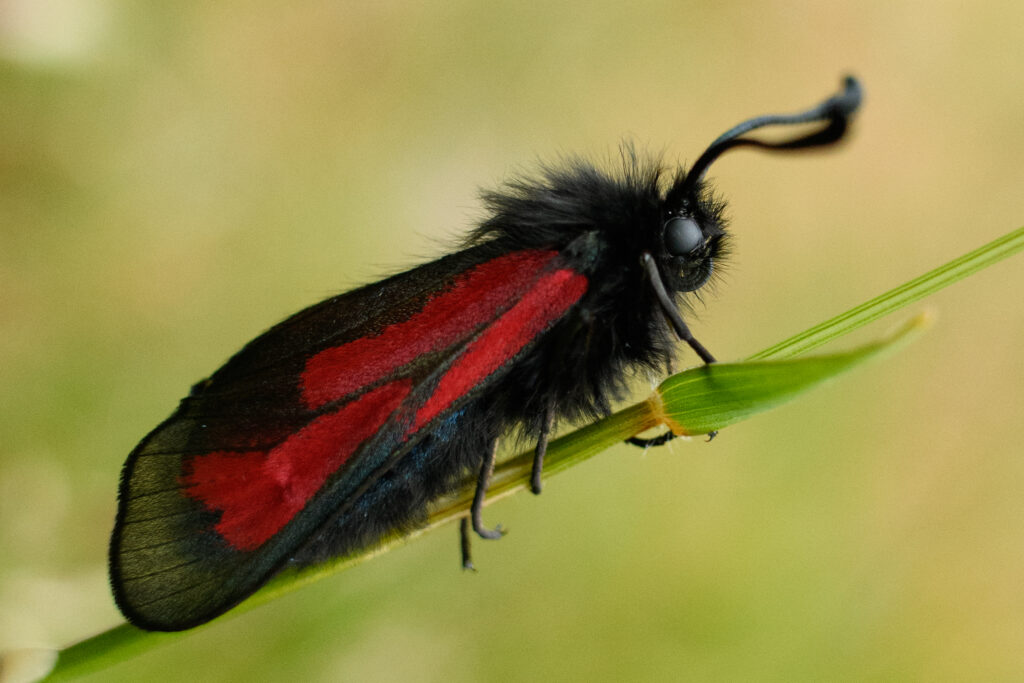
Overwintering as a caterpillar, it is single brooded, on the wing from early June into July. This year I saw my first moth on the 29th of May – slightly earlier than is usual, as was the case with many species this year.
In Scotland, it is quite restricted in its range and is only found in certain areas along the west coast. The mild climate created by the Gulf Stream is part of the reason for this distribution.
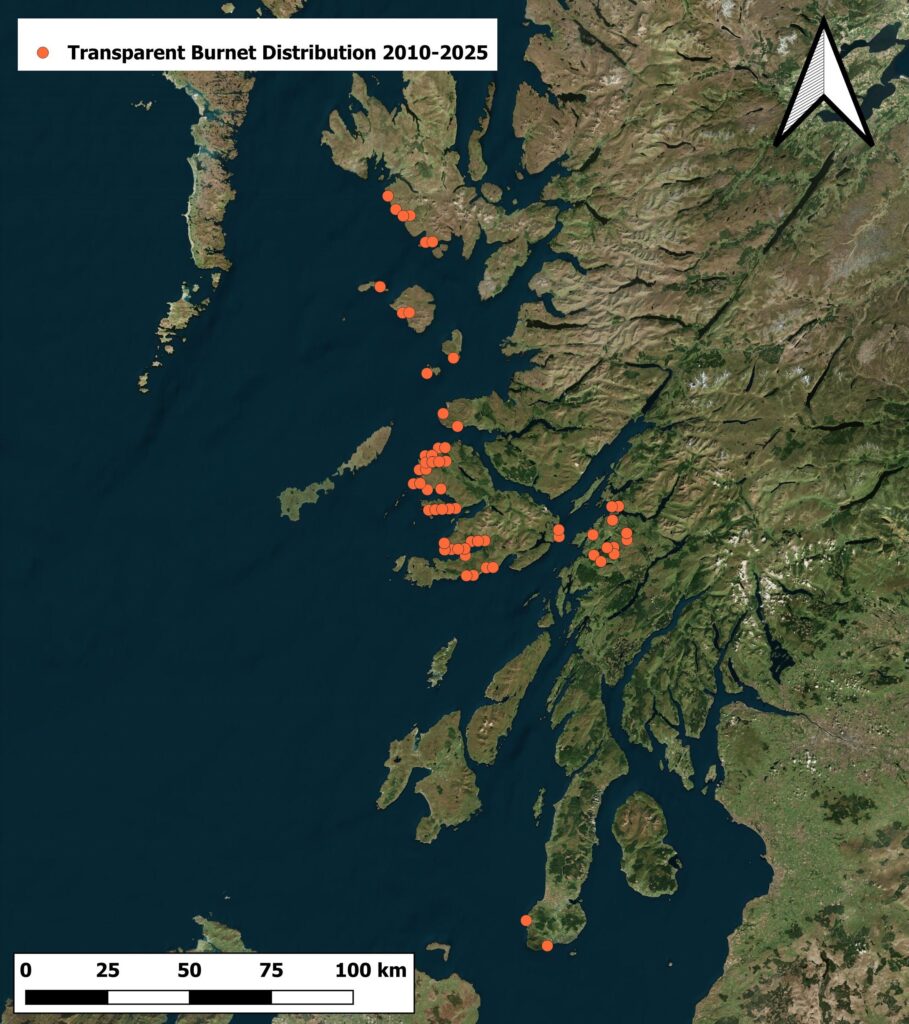
Almost all the Transparent Burnet colonies in northern Argyll have 4 commonalities. These are as follows 1) basaltic rock, 2) southern facing slope, 3) exposed rock and lastly, and most importantly 4) an abundance of their larval foodplant, Wild Thyme.
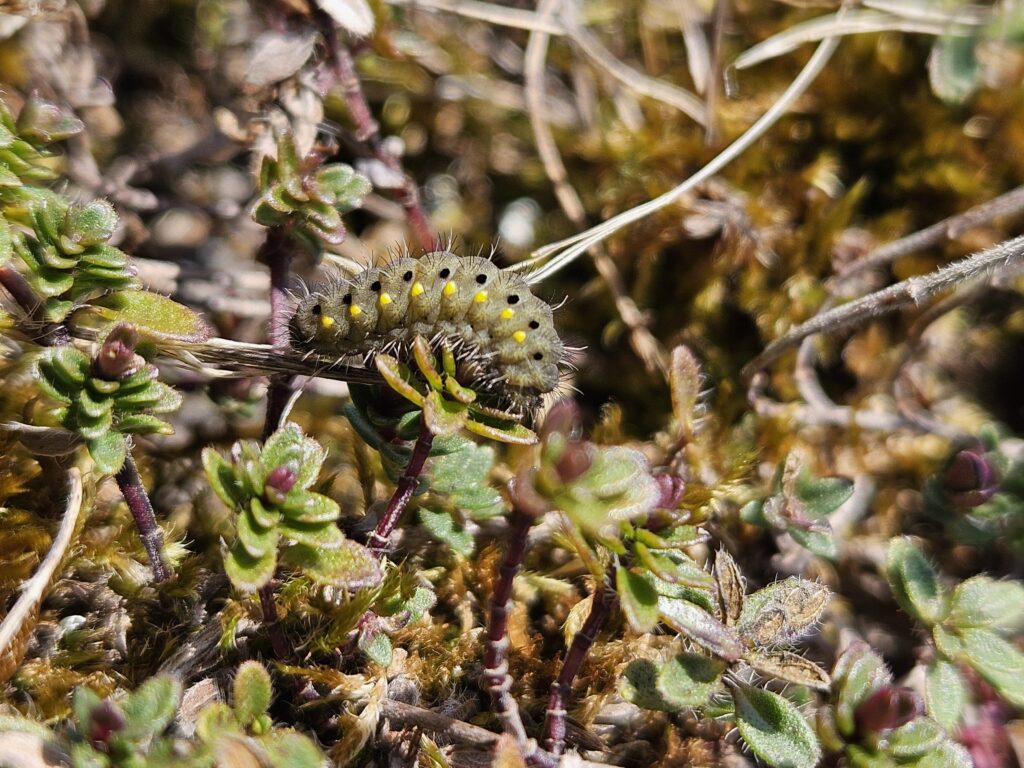
This summer, as a part of my traineeship with Butterfly Conservation and Species on the Edge, I performed extensive surveying of this moth. I aimed to determine if there have been any significant changes in their distribution in the northern Argyll area. To do this I first surveyed known sites in order to familiarise myself with what ‘good’ Transparent Burnet habitat looked like. I then surveyed surrounding areas of these known colonies to look for colony expansion, sites with historic records, and areas of suitable habitat that do not have any records.
To identify areas of suitable habitat and hopefully find unrecorded colonies, the aforementioned habitat characteristics allowed me to narrow down my survey area considerably. I first considered the geology and mapped the areas of basaltic rock in mainland northern Argyll which gave me a search area of around 60,000 hectares. To further refine my search area, I then considered the second and third habitat characteristics – southern facing slopes and exposed rock. These craggy areas can be identified using aerial images, and the slope of the site confirmed with topographical maps.
Shown here are all the areas I found in northern argyll that possessed these three habitat characteristics.

That’s a lot of sites! Many of these sites in the south are quite far from the coast and from the nearest known colonies, so they are very unlikely to be occupied and therefore were a low priority for surveying. Some other sites were too high in elevation and likely to be too cold for the moth to survive, so I removed these from the list. Lastly, certain sites were simply inaccessible and so were not surveyed.
Having identified my survey sites, all that was left to do was get out there and try and find some moths! I surveyed for the fourth habitat characteristic – wild thyme – and depending on the time of year, either larvae or adult moths. In a few cases, I surveyed for larvae and found nothing but decided to revisit during the flight period to be sure because the habitat looked ideal.
Altogether I visited 20 sites for Transparent Burnets. At 15 of these sites, I was hoping to either rediscover historic colonies, to extend existing colonies, or find entirely unknown colonies. I also performed timed counts at four of our known colonies, to contribute to annual monitoring efforts.
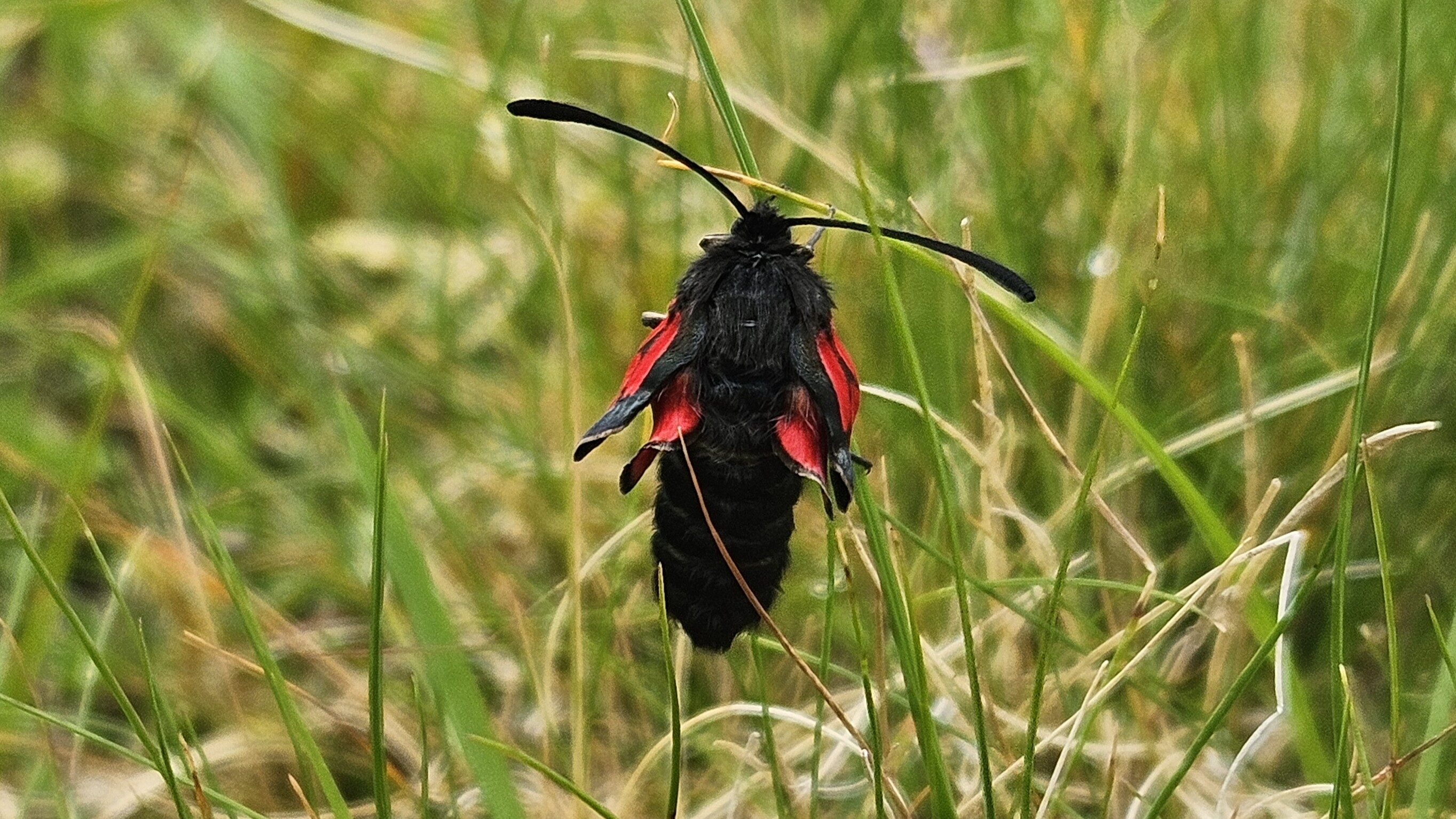
At one of these monitoring sites – Beinn Lora – I led a group in a guided walk to the colony at the peak of the flight period. It was quite spectacular how many moths we spotted. One attendee even found a moth so recently emerged from its chrysalis that its wings hadn’t fully developed yet.
In the end, my surveys increased the extent of three existing colonies and rediscovered three ‘lost’ colonies. The moth had not been recorded at these ‘lost’ colonies in a long time (around 40 years in two cases) and we did not know their exact locations. With this information we can now work to monitor and maintain these sites. No evidence was found to indicate significant changes in the moth’s distribution in northern Argyll, and it is possible that with the factors of climate and geology, the moth is occupying the general extent of its current potential range. With a changing climate however this could change, so it would be interesting to see the results of a similar project a few years from now.