Endemic
Guest blog post written for Species on the Edge by James Harding-Morris, author of Endemic: Exploring the wildlife unique to Britain
When I worked as Communications and Engagement Manager for Back from the Brink – a sister project of Species on the Edge in England – I found myself constantly drawn to the oddities; the overlooked, the rare, the subtly mysterious species for which Britain has a particular responsibility. Back from the Brink was a sprawling, England-wide effort to help some of our most threatened wildlife, and it was during that time that I became fascinated with one very specific category: endemics.
Endemics are species found only in a particular place. In the case of British endemics, that place is here, and only here. No backup populations overseas. No second chances. If we lose them, they’re gone for good.
Several such species featured in Back from the Brink: the Prostrate Perennial Knawel of the sands of Breckland; the Interrupted Brome, a grass that managed the rare feat of going extinct twice; and the Western Ramping-fumitory, all frail elegance and alien poise. After the project ended, I kept digging. I realised there was no comprehensive list of British endemics, so I began collecting references. Those references became a journey, and that journey became a book: Endemic: Exploring the Wildlife Unique to Britain.
In the book, I travel around Britain tracing the stories of our most unique species. One of those is Primula scotica, the Scottish Primrose, a species that clings only to the wild fringes of our northernmost coasts and the Orkney archipelago. It is also a species that Species on the Edge is helping to protect, which makes it the perfect time to share the story of how I tried to find it.
A first attempt
Back in May 2023, I took the ferry to Orkney with my friend Robert. I had two endemic targets in my sights: the Scottish Primrose, and the Orkney Vole, an endemic subspecies of the Common Vole, which, despite its name, doesn’t live anywhere else in Britain at all.
I’d read that the primrose was reliably seen at Yesnaby on the west coast of Mainland, but John Crossley, the BSBI recorder for Orkney, suggested I search somewhere less well-trodden: the north-west coast of Rousay. “Everyone goes to Yesnaby,” he said. “We need people to check places that haven’t had recent records.” That sealed it.
The ferry to Rousay took just twenty minutes, enough time to sit in a car on a boat, watching stiff-winged fulmars slice through the air only metres away.
After Robert dropped me off near the Loch of Wasbister, I walked towards the cliffs. The day was overcast, with wind needling through my layers. The terrain was open and tussocky, rich with flowers: spring squill, cuckooflower, thrift, and the dainty fronds of crowberry. But no primrose.
Then came the rain. It lashed down sideways. I took off my glasses because they were useless in the downpour and squinted through the blur. Was I too late in May? Too early? The Scottish Primrose blooms twice, once in May, again in July, and this was the very end of the first window.
Then, just as the rain cleared, the bonxie came.
It whistled past my head with startling speed. I spun round just in time to see it wheel high above the clifftop and come back for another pass. Bonxies, Great Skuas, are infamous for dive-bombing intruders near their nests, which I guessed must be nearby. I ducked the first two swoops, but when the second skua joined the attack, I retreated, escorted off the headland by two dark-winged pirates.
I made it back to the road without seeing a single Scottish Primrose.
“Find your flower?” Robert asked when he picked me up.
“No,” I said, and told him about the bonxie attack.
He grinned and shook his head. “I’m really jealous,” he said. “I’d love to be hit in the head by a bonxie.”
I hope that the primroses of Rousay are still there, and someone with more luck and fortitude than I can find them.
A second try
The next day, back on Mainland after another unsuccessful morning of checking our Longworth traps for Orkney Voles, we set out for Yesnaby. It was bright and clear, but the wind was still fierce.
Yesnaby is all stark beauty: sea cliffs, relics of wartime batteries, and salt-pruned turf studded with spring squill and kidney vetch. A wheatear flicked past. We walked away from the cliff edge, reasoning that the flowers might be better inland, out of the brunt of the weather.
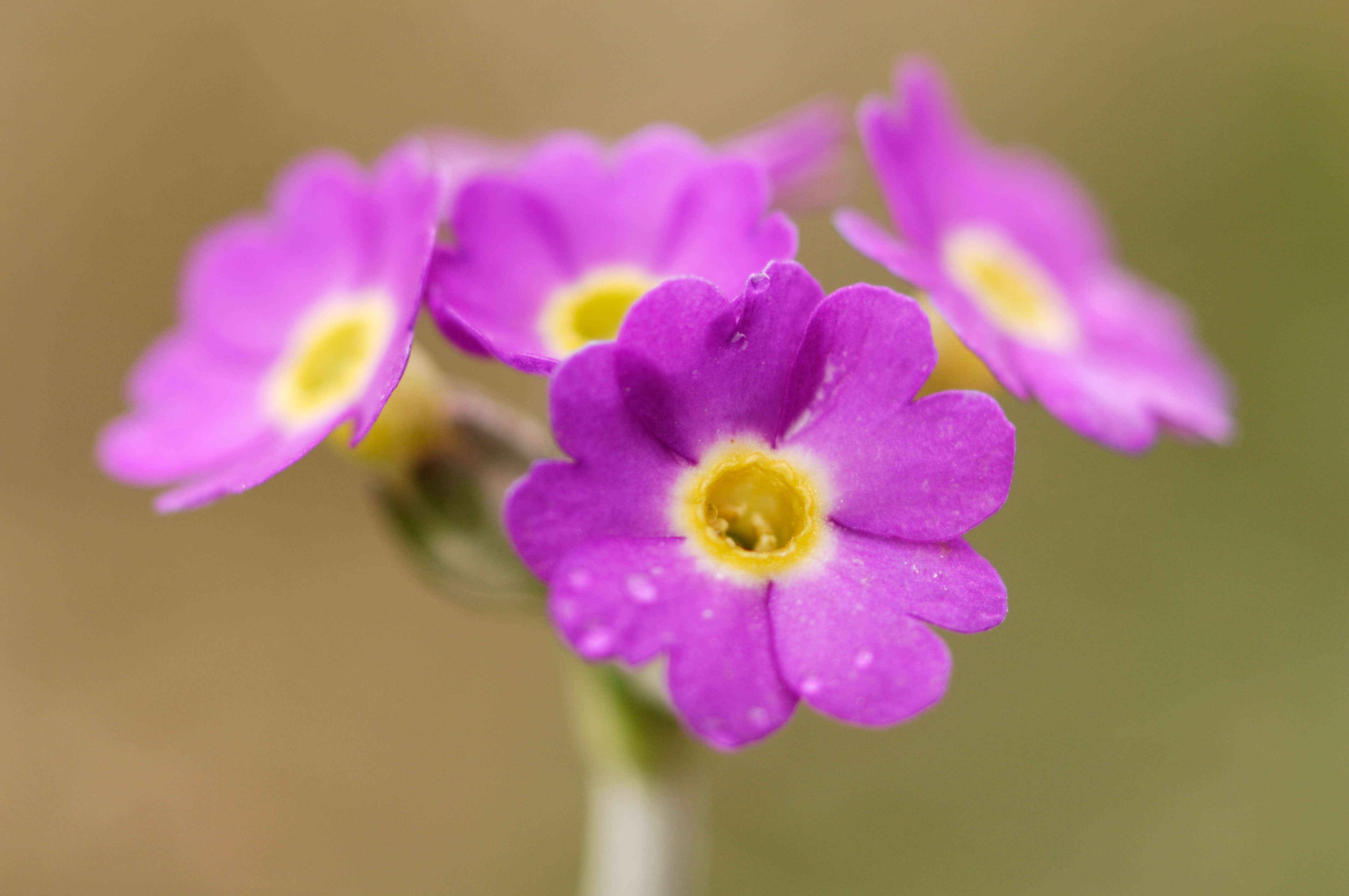
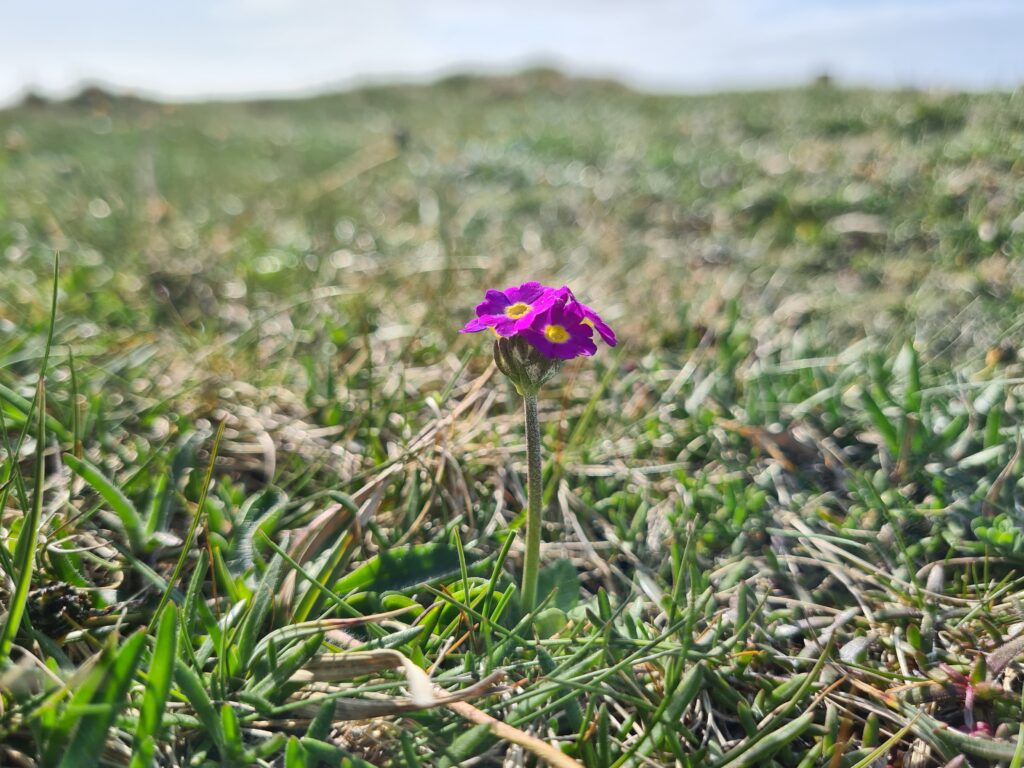
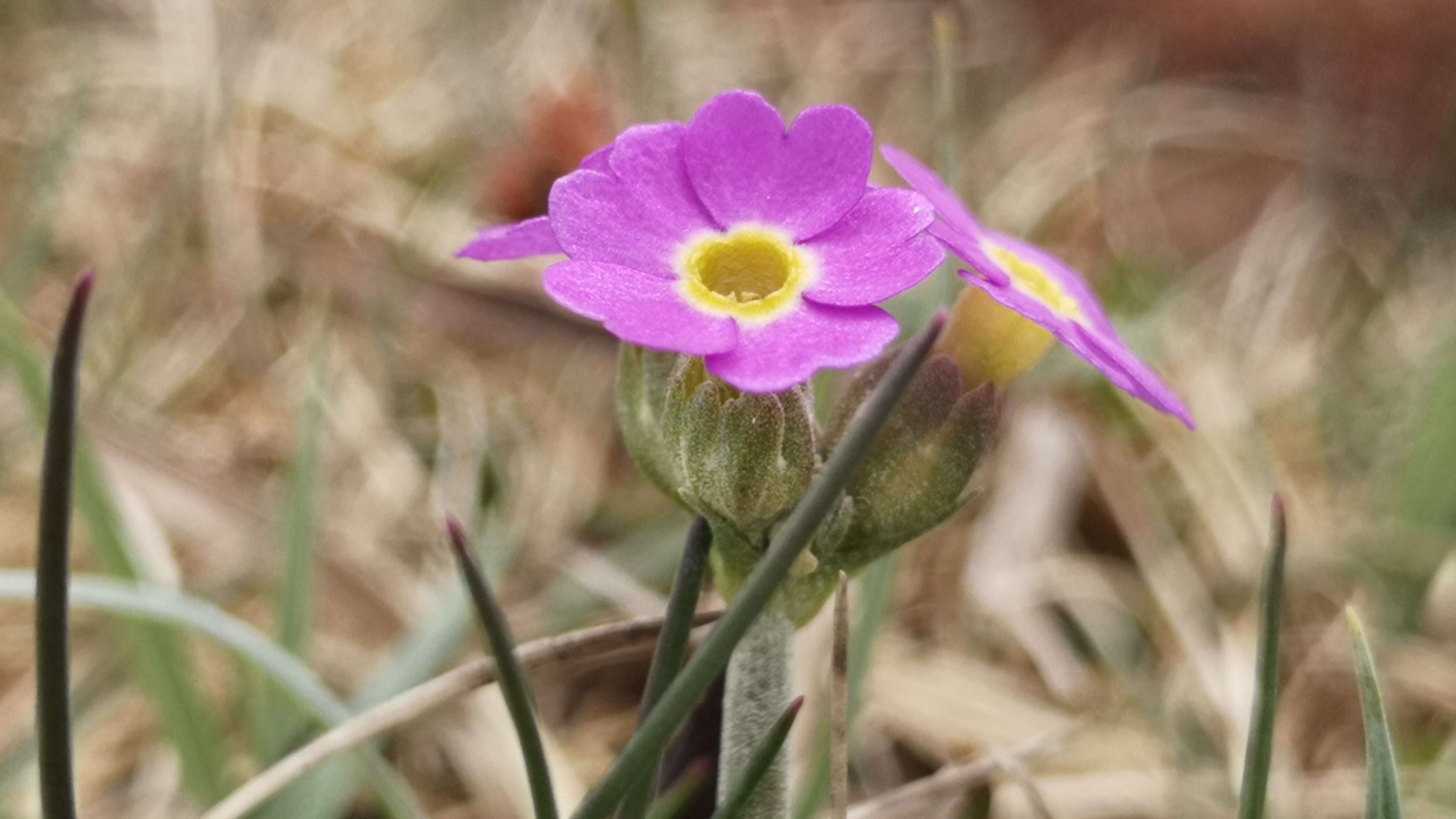
And then, like a shard of amethyst in the turf, I saw one. A Scottish Primrose. Smaller than my little fingernail, and somehow even more delicate than I had imagined. One flower remained on the plant I found first, five heart-notched petals in a rich, vibrant magenta, surrounding a lemon-yellow centre. The flower stood on a stem just three centimetres high, emerging from a tiny rosette of dusty green leaves. Everything about it was miniature and exact.
I called Robert over, and while he photographed it, I wandered nearby. Almost immediately I found another, in perfect bloom: five flawless flowers jostling for space on a single stem. With my eye now tuned in, I saw more; some already finished flowering, others still holding their faded petals like decorations left after a party.
We lay on the sun-warmed turf taking pictures, sheltered from the wind by our closeness to the ground, as a skylark sang above us. The flowers dotted the grass like gems.
A place for special species
Though they are not endemics, Orkney is also an incredible place to see some of our other rare and special species. I visited a beach that seemed crammed with the sprawling glaucous leaves and warm blue flowers of Oysterplant, another Species on the Edge target. I visited The Gloup in the west of Mainland and saw my first ever Great Yellow Bumblebee. And, finally, after days of dashed hopes, I did eventually see the endemic Orkney Vole.
But I think it’s the primrose that most captured my heart. We have, perhaps surprisingly, more than 600 plant species endemic to Britain. Many of these belong to a few speciose groups – nearly 300 hawkweeds, nearly 150 brambles, around 30 dandelions, about 40 whitebeams – and all of these endemics are important, and beautiful (I’ve seen dozens of endemic whitebeams over the last few years and I love every single one of them). But there is something about the Scottish Primrose being particularly unique, standing alone as a stand-out endemic with nothing else like it in Britain. That’s why it graces the front cover of Endemic.
Survey and monitoring, habitat creation and restoration for the Scottish Primrose is vital. But just as vital as the science and stewardship is the storytelling; the interpretation, the engagement, the opportunities for people to understand and appreciate these special species. People protect what they care about, and Species on the Edge is giving people that opportunity to care.
It’s also why I wrote Endemic. It’s a celebration of the stories of the utterly unique: from mosses and woodlice to beetles and buttercups. These are species that exist only in Britain, many of them found nowhere else on Earth. Through journeys across the country, I’ve tried to bring their stories to life; to explore what makes them special, why they matter, and what we stand to lose if we let them slip away. My hope is that it helps more people to notice, and to care.
Endemic is available here.